
Jordan - harmony found
- Rhoda Phillippo Harrington
- Apr 26
- 22 min read


We set off on our Jordan adventure after a lovely week with Jack, Megan, Magnus and Leif in Dubai. We arrived late Friday afternoon and Muhannad was there to meet us. Our week has been arranged with Al’a Alshareef (contact details below) who was a recommendation from Amanda Zeidan (Jihane's bridesmaid) who works at the US Embassy in Jordan. We are staying at the Sheraton Amman Al Nabil hotel which is in the 5th circle – Jordan’s areas are called circles. Our room is lovely with a balcony looking out over the city and plenty room. We have access to the club lounge so spend our first evening with snacks and a few wines and catching up on world news…..little were we to know what was awaiting us the next day!
I had eaten something on the plane from Dubai to Amman which clearly didn’t agree with me so Saturday started slowly as I couldn’t face eating or drinking. We were scheduled for a city tour with Al’a. News that the US and Israel had attacked Iran came as something of a shock. Although we knew that some kind of conflict was likely, to the best of our knowledge the parties had been negotiating just the day before. We met up with Al’a for the first time at our hotel and set off to explore the city of Amman. The sound of the air raid sirens was one that we were to become used to over the course of the week.
We had purchased a Jordan pass before our visit https://www.jordanpass.jo/ and this proved to be good value as it gained us entry to most of the sites that we visited during the week. We needed our passports with us for most sites too and I don’t think this was to do with the war going on.

Our first stop was the King Abdullah Mosque (the blue mosque). I had to be dressed from head to toe in a black abaya before I could begin the wander around. The mosque was completed in 1989 as a memorial by the late King Hussein to his grandfather, and can house up to 7000 worshippers, with a further 3000 in the courtyard. There is also a small women’s section for 500 worshippers and a much smaller royal enclosure. The cavernous, octagonal prayer hall is capped by a magnificent blue dome 35m in diameter, decorated with Quranic inscriptions. This is the only mosque in Amman that openly welcomes non-Muslim visitors.

We travelled from here to the Byzantine Citadel, a 5th century church considered one of the oldest in Amman. The nave had a beautifully preserved mosaic floor and a Greek inscription which reads “was paved with mosaics by diligence and care…”. On the same site was the Temple of Hercules – it was probably a temple to the Ammonite god Milkom and during the Roman period it was dedicated to the Roman god Hercules, the son of Zeus. We could see the likeness to places that we visited in Athens last year. The ancient name of Amman was Philadelphia. Both are situated at the highest point of Amman so the views of the city were fantastic. Amman is so much more hilly than we expected.

After a stop to view the Roman Theatre from above we drove down to visit the site itself. The Roman Theatre is the most impressive monument of old Philadelphia, as Amman was known on the frontier of the Roman Empire in the southeastern Levant. According to an inscription, it was built during the era of the Antonine emperors, at the end of the 2nd century AD. Its tiered, semicircular seating space is carved into the Jabal Al-Jofeh hill in three horizontal sections with a total of 44 rows which can seat around 6,000 people. It faces north so that the audiences are protected from the sun. Social rank dictated the places for the audience. The urban poor, foreigners, slaves, and women were restricted to the upper section. The stage building, about 100m wide, was probably three storeys high. The wooden stage elevates 1.5 meters from the chorus performance space for the orchestra. Today, the Roman Theatre is again in use for performances, concerts, and events. In addition, halls on both sides of the stage house two small heritage museums: The Folklore Museum and the Museum of Popular Traditions. The row of columns in front of the theatre is what remains of the colonnades which flanked the Roman Forum, a public square, once among the largest of the Empire. East of it is the Odeon, a smaller Roman auditorium for musical performances. Tim climbed to the top row to take photographs while I stayed at the bottom and laughed at the school children playing and the teacher trying to keep them in check with his whistle. Our final stop was for a walk down Rainbow Street – the main and colourful street of Amman with every type of restaurant that you can imagine in it.
We headed back to the hotel where I slept for several hours while Tim downloaded his photographs that he had taken.

I woke feeling much better on Sunday. The day started with a trip to several shops to try and find a replacement card for Tim’s camera which had corrupted. Al’a put a great deal of effort into this, ringing all his contacts to try and source the right card. Eventually he had one delivered to his home that evening and Tim was back in business from Monday. With this all done we headed to Ajlun Castle, located about 1123m above sea level and built in around 1184 AD. It was built to protect and secure the area and was also the location for pigeon post. It provided for the safety of pilgrims from Damascus to Jordan and also the trade caravans which travelled to Hejaz. Under the Ottomans the castle was used as a military garrison right up until earthquakes damaged it in 1837 and again in 1927. It was listed in the Islamic world heritage sites by ISESCO in 2019. It had a truly great display of arrow slits and defence towers. This was probably the day that we realised that we were going to be very fortunate in our visits as there were few tourists and we were at leisure to wander around and learn about places. The castle had another wonderful Byzantine church in the upper and oldest part. Part of its mosaic floor is still intact, showing the motif of loaves of bread and two fishes representing Jesus’s miracle of feeding the multitudes. This church reinforces historians views that the castle was built on the ruins of a monastery.
At the castle we also found a very useful board that showed the historical periods/ages – as we are not historians it would prove helpful to place what we were to see over the course of the week. While it is not quite spring yet, the countryside is starting to turn green with yellow, white and purple flowers peppering the green hills.
From Ajlun Castle we made our way to Jerash often described as the Pompeii of the East. We were keen to visit this having been to Pompeii on our European travels last year. Jerash proved to be one of the great highlights of our visit to Jordan. As we entered the site we made our first tourist error, waylaid by a couple of shopkeepers who quickly sold us both Jordanian and Palestinian scarves. Al’a had warned us not to be lured in but to wait to do our shopping in a genuine shop he would take us to later in the week, however we were not unhappy to put our tourist dollars to help the locals here. Jordan is a very expensive country to visit when you are using Australian dollars (worth about 0.5 of a JOD) so we did not make too many more mistakes like this!

The city of Jerash was home to about 20,000 people and was visited by the Roman Emperor Hadrian in 130AD. The first site we came to was the Hippodrome built for chariot racing (220AD). It is the smallest and best preserved Hippodrome of the Roman Empire with the arched starting gates where the horse would be positioned still in place. By the late 4thcentury the northern part was transformed into an amphitheatre for gladiator fights and other sports. Walking further into the site (which we soon discovered was massive) we came to the Oval Plaza which is truly stunning. It’s oval shape is quite unique and it was built to connect the main street to the sanctuary of Zeus. Built around 110AD its symmetry was quite breathtaking. As we took it all in the air raid sirens sounded adding a quite surreal feeling to the whole experience. We wandered further north to the Northern Theatre which was equally well preserved and just the two of us to admire it. Again it had a beautiful mosaic floor and incredible views across the valleys. We could hear bombs exploding from here, re-inforcing how close to the conflict we are.


After this visit Al’a had organised lunch for us at Al Khayyam restaurant in Jerash. The road back through the town passes supermarkets with whole goat carcasses hanging outside as well as live goats popping in and out of the shops. It is Ramadan this week so all Jordanian Muslims are fasting. We are the only people in the restaurant and it has been opened at this time just for us! We feel quite honoured but also mean eating while they are fasting. We order too much as I have not eaten for a couple of days – the main dishes are called Fukhara and served on flaming salt in pottery dishes and are delicious. We don’t need much to eat in the evening as we have had lunch so late and return to the hotel to relax and catch up on the war news before our big trip tomorrow.
We are up early to use the gym on Monday – it is huge and there is only us in it. The night has been interrupted by sirens and the sounds of missiles being shot down – a stark reminder of where we are. Today we are to start our visit in Madaba. Al’a has Tim’s card for his camera so we are back in business. As we drive out of Amman we see a cycling group and hear a police car. Al’a tells us that the police will be driving with the cyclists to make sure they are safe and that there will also be an ambulance escort. How wonderful to have this level of protection. We discover that Al’a does not like the main roads so are treated to a very scenic drive. We stop on the way to Madaba at a wonderful shop called Dead Sea Treasures that sells Dead Sea beauty products and many other Jordanian treasures https://wowjordan.com/en/listing/dead-sea-treasures-amman-jordan/ We buy necklaces for Joey and Aurelia’s birthdays and small gifts for others. Upstairs the shop has the most amazing display of mosaic furniture which we have ever seen.

Madaba is lovely with cobbled streets and Moab art shops. We visit the Greek Orthodox Church of St George which has the most amazing mosaic floor depicting Jerusalem, Bethlehem, the Dead Sea, Jordan River, Jericho, the Mediterranean Sea, Mount Sinai, the Nile Delta, Karak, St Lots Monastry and Hebron. The church has beautiful painted ceilings and is a calm oasis in the busy town of Madaba.

From here we head to Mount Nebo. The views from here over the Jordan Valley are superb – our weather has been stunning since we arrived and the tranquil nature of the area makes for quite a spiritual encounter. The mountain is meant to be the site of the biblical event described in Deuteronomy 34 where Moses climbed the mountain and the Lord showed him the Promised land. No one knows exactly where Moses is buried but it is believed to be in the valley in Moab below this mountain.

In the middle of the site is a brazen serpent monument which depicts a serpent on the cross and is meant to represent the serpent on a pole that God told Moses to erect as protection against poisonous snakes.

From here we take a route down from the mountains to the Dead Sea where once again Al’a has organised lunch for us, this time at the Crown Plaza resort hotel. A very enthusiastic hotel concierge shows us around the site on a golf cart and takes us to the edge of the sea. We would have loved to have time to float but we are on a tight timescale as we have one more visit after lunch. Lunch here is a buffet style and we are not the only guests as one other table of American tourists shows up to have lunch too! I had a plate of the most massive and delicious olives I think I have ever tasted!

Our last stop of the day is to the baptism site where John the Baptist baptised Jesus. The site is a military one and closes at 4pm and we didn’t arrive until 3pm so it was a very quick visit. The River Jordan is actually the border with Israel so we stood just meters from Israel as the sirens sounded and we could hear the missiles dropping. This was very surreal. The Israelis have blocked the flow into the river so it is little more than a trickle now. Historians are sure this is the actual site of the baptism as over the years all different denominations have erected places of worship in the area.

We headed back to Amman as we were to meet Amanda for dinner this evening at the wonderful Alee restaurant https://alee.group/ We had been due to do this on Saturday but as I was ill we postponed. On the way back we comment that we haven’t seen any motorbikes – Al’a tells us that it is forbidden for Jordanian’s to ride them as they are very dangerous. Out of Amman the driving is actually quite manic and I am grateful that we have Al’a taking care of it. Our driver from the hotel to drop us at Alee for dinner with Amanda spent three months driving for film crews in Wadi Rum while they filmed Star Wars and Mars there! As we wait for him we watch a missile being shot out of the sky. It is great to catch up with Amanda and also get her perspectives as she works in security and political briefings in the US embassy here. We talk about arranging flights for us to leave and she gives us some very good advice.

We are leaving very early on Tuesday to head to Petra so we check out of our hotel and Al’a is waiting for us. We head over to the coast and drive down the length of the Dead Sea on the way south. I spend a great deal of time on the phone trying to re-arrange our flights home and eventually manage to get a flight with Royal Jordanian on Friday 6th March to London and then a Qantas flight home via Perth on the following Monday so we decide that we will surprise Joey (she turns 60 in April) with a weekend visit when we get to the UK. Al’a has decided that Tim is his personal photographer and so many photos are taken of him in his Bedouin dress. We get to Petra around 1130am and have a drink in the Movenpick hotel (Al’a is also a rep for Movenpick ice-cream so has access to these lovely spots for rest and refreshments). We walk across the road to the entrance to Petra and meet our guide Yousef. Petra does not disappoint as one of the seven wonders of the world. The walk and the history is stunning as is the level of preservation of something that is this ancient.

Yousef is very knowledgeable and also proves incredibly adept with my phone so the photos are a cut above what I would have managed myself. It is not known precisely when Petra was built, but the city began to prosper as the capital of the Nabataean Empire from the 1st century BC which grew rich from trade in frankincense, myrrh and spices. It was annexed to the Roman Empire and continued to thrive until a large earthquake destroyed much of the city in the 4th century AD. By the middle of the 7th Century AD Petra appears to have been largely deserted and it was then lost to all except the local Bedouin people. In 1812 a Swiss explorer named Johannes Burckhardt set out to rediscover Petra and since this time it has become a fascinating and beautiful ancient city. It is also know as the rose-red city, a name it gets from the wonderful colour of the rock from which many of the city’s structures were carved. After passing the place where a horse can carry you for 800m we pass the Djinn blocks which are huge square monuments and the Obelisk Tomb carved in the 1stcentury AD- this tomb and a bas-relief of five people indicate that the tomb was to be used for the Abdomanchos family.

We head through the Siq which is an amazing gorge with the water channels built into one side and the animal troughs on the other. The colours are incredible as are the tombs and dwelling places along it and the original paving in the path. It is 1.2km long and was created by a natural splitting of the mountain. We eventually come to the Treasury (Al Khazna) which is much more magnificent than it appears in the movies and Yousef gives us a detailed explanation of the carving and what we are looking at. It is almost 40 metres high and intricately decorated with Corinthian capitals, friezes and figures. It is crowned by a funereal urn which legend says holds treasure. From the Treasury we walk along the street of facades where there are more carved tombs.

We reach the theatre which is very similar in design to the ones that we have seen in Amman and Jerash and likewise comes from the Roman era. We head along Colonnaded Street to the Royal Tombs of which there are four again with magnificent facades. At this point we turn back and decline a golf buggy back up the hill and walk back the way we have come enjoying the amazing sights on either side of us.

We are back with Al’a by 330pm and into the car to head to Wadi Rum (valley of the moon or red mountains), about a 90 minute drive. The scenery changes again here to be more arid and sparse. We arrive in Wadi Rum village and we are met by Khaled who is the co-owner of Mars on Earth https://www.marsonearth-wadirum.com/en/home/ a company referred to us by Amanda. He and his wife Claire run the camp. Claire is French and visited Wadi Rum several years ago, fell in love with Khaled and now lives in the Bedouin village with him and runs the camp. There are 45 Bedouin families that live in Wadi Rum and they are all related to each other. We are struck by the purity and simplicity of the lifestyle. Khaled drives us the 20 minutes to our camp in the desert and shows us to our “Love Room” – it is quaint and cold in the desert as the sun has dropped behind the mountains.

Khaled and the chef show us how they drop a zarb into the ground – a traditional Bedouin cooking method which has three levels with rice on the bottom, vegetables in the middle and chicken on the top. The steel three level zarb is dropped into a circular can dug into the desert and then a lid, carpet and sand are heaped on top. It is genuinely a Bedouin version of a slow cooker, used by them to put food on to cook while they tend to sheep, coats and camels in the desert.

We head out for a walk and then come back to join other guests in the communal “restaurant”. The space is large with tables around the outside and a huge fire in the middle. We are joined by various travellers – Czech, Russian, German, Canadian, Chinese…..and because there is no mobile service a very pleasant exchange of stories and travel adventures. The Chinese man Di (pronounced Dee) proves to be very good company – travelling on his own and planning the next day to get a ferry across the Red Sea to Egypt and find his way home that way. Everyone has a story to tell because of the war and ideas to share as to how to get home. Peter, Marie and their two teenage children from Czech are also good fun and looking for ways back home. Khaled talks to us about our chosen trip the next morning and we are delighted to find out that we will be just the two of us with Hammad as we head to the south of the desert. Dinner is served and as well as the slow cooked meat, rice and vegetables there is an amazing array of salads and Arabic bread to choose from. The food is really delicious and we toast our bread on the open fire. There is copious amounts of herbal tea which despite being sweet is very nourishing. We realise that our clothes will smell of wood smoke for days to come! At around 930 pm we head back to our hut – the stars and the full moon in the sky are amazing. It is very cold so we get into bed fully clothed and enjoy our secret store of wine brought with us in a sports drink bottle. We eventually warm up and fall asleep only to be woken at 1am by the sound of a massive bomb dropping. We find out the next day that this was dropped on Elat. The sound was terrifying even from where we were 70 km’s away.

We wake quite early and head to join everyone for breakfast in the communal restaurant. Once again there are fresh eggs, Arabic bread to toast and other goodies. We note that our fellow travellers can eat – I might have had an egg but they were all gone very quickly. At 9am we head out with Hammad for our day trip. Our first stop is 45 minutes away and despite the blue skies it is chilly on the back of the truck so we are glad of our extra layers. We arrive at the Jedal Burdah Rock Bridge where Tim is brave enough to climb to the top – I am happy to photograph him from the bottom. There is a small Bedouin tent and shop there and an Indian woman who clearly lives there and speaks great English.
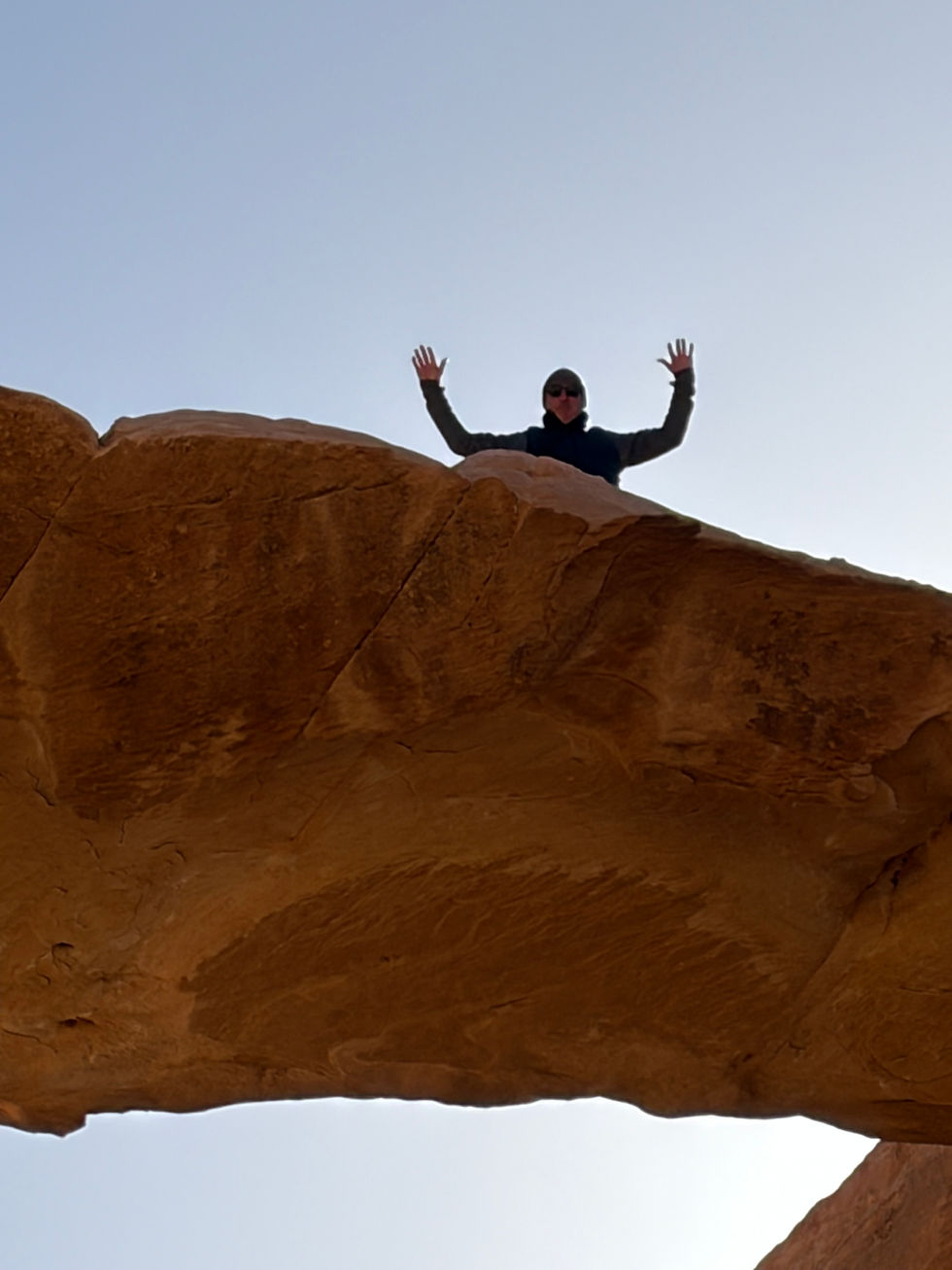
After Tim’s climb we head another 45 minutes south passing the highest peak in Wadi Rum – Jabal Ad Umm Dami - which we had discussed climbing the day before with Khalid but decided that the one Hamman chooses is probably more suited to me. Hammad accompanies us on the first part of our journey up Jebel Al Hash, which is a climb for about 15 minutes and then points us on our way for the 45 minute climb to the top. Spring is just coming to the desert and there are beautiful tiny white and purple flowers in the sand and the Black Iris – the symbol of Jordan. We see a plant - a drimia maritima which looks like a cactus above ground and is an onion below the ground and when cooked and ground up serves as an anti-inflammatory. We also smell a menthol plant which is better than any man made menthol we have ever smelled. There is a violet cistanche growing out of the sand – it looks like a purple bottle brush and is very rare.

Hammad points out a barbed wire fence and jokes that it is the Saudi border – it is actually what they use to stop the camels wandering over the border. When we reach the summit we look out over the Saudi Arabia border – and weirdly Telstra tells us that we are now roaming in Saudi and we have mobile service for the first time in 24 hours (and of course a Telstra charge of $10! We wonder what they will say when we challenge that we have never been to Saudi!) It is truly beautiful where we are and Tim climbs to the very top while I sit and enjoy the views in every direction. There is something deeply calming – sitting in a place where we are just a tiny insignificant dot on the earth. I don’t think I have ever felt anything quite like it. We walk back down to join Hammad who has made us more sweet herbal tea over a fire and chat to him about his family. He is one of 10, 4 brothers and 5 sisters and although he went to school for a couple of years he didn’t like it. He speaks really good English, all of which he has learned from these tourist trips. We decide that we will go and meet his family later in the day. He is worried about the impact the war will have on the country as they rely so heavily on tourism. On the way back down the hill he shows us the fossils in the rocks here – dating back millions of years.

Our next stop is at the bottom of a huge sand dune about 45 minutes further into the desert. Hammad points us on our way and leaves us to drive through a canyon and cook our lunch. We walk up the sand dune which is a great glute and calf workout. There are only our footsteps here. He tells us that what we will see is his favourite place in Wadi Rum and we can understand why when we get there. The rocks are blue and absolutely stunning. Further on they are red and once again we are struck by the colours and diversity in this place far from anywhere. Here again we can see Saudi Arabia in the distance.

Hammad has told us that you can’t cross the border now – you used to be able to but there are guard posts every 1 km. We find our way back down to the canyon and walk about half way through it to find Hammad. He has made us a tomato pasta over an open fire and there is hummus, labneh and Arabic bread to go with it. We sit on a rug and find out more about his life and enjoy a wonderful lunch. We feel bad as he is observing Ramadan so doesn’t eat or drink anything. Refreshed by our lunch we drive another 30 minutes to visit the first well that the Bedouin constructed in the desert – one for people and one for camels – thousands of years ago, taking advantage of a point where water would run off the mountains when there is rain.

We head towards Hammad’s mum’s tent passing an albino camel and baby on the way. Hammad explains that everyone has their own branding on the camel so he knows these are not his family’s. We arrive at his family tent where there are goats, sheep, chickens and a couple of camels – one male and one female that are kept on opposite sides of the camp at the moment as the male is in season. We are introduced to Hammad’s mum and oldest sister and the two youngest sisters Khalia and Fanti – they are nearly 6 and 9 years old. There is also a younger brother there but he is shy and doesn’t interact with us. Hammad explains that we mustn’t take photos of the females but that anything else is ok. His mum makes us tea and the two girls take me to see their baby goats – capturing them with ease and telling me that all their names are Lulu. There is a black and white one so I tell them its name is Domino and they like repeating that. The language barrier is nothing with smiles and gestures making it easy to communicate. We are moved by how simple their lives are. Their generator isn’t working so Hammad tinkers with it to get it going. There are white balls on top of a makeshift tent like structure and Tim asks if they are eggs – Hammad’s sister hands me one and it is goats cheese drying in the sun – very salty but also delicious. Hammad tells us that they move the tent whenever they need to go to greener places for the animals. It has been very dry for a time so they are where they are far south to provide grass so that the animals produce milk which is vital for the Bedouin to make cheese and drink. I ask if his sisters are also observing Ramadan and he says not the youngest one but that the 9 year old is doing partial Ramadan as training.

We say farewell and we drive further north to where Hammad’s uncle and aunt have their tent. The uncle lies on the mat inside the tent and talks to Hammad about what we have seen today and whether anywhere is green. To our ear they always sound like they are arguing but Hammad explains that they just talk very passionately about everything – we have witnessed this with Jihane and her family so we understand. We go out with the aunt and she effortlessly milks goats and lets us let the babies out to have a feed with their mums. The goats and sheep are of all different colours and in great shape. We love their long ears. It is time to say goodbye and head back to the village to meet up with Al’a again. On the way back Hammad stops and I get to stroke one of his family’s camels – so soft and they don’t smell in the desert.

We stop at the village to pay Claire for our experience – she tries to take less money from us as we didn’t have dinner on the second night but we refuse – it has been such an amazing experience and probably the best value of all our trips in Jordan. Something we will never forget. I promise Hammad that I will send them this blog and post it so that others come and have this unique experience and he says that he will look out for it.

Back in the car with Al’a we drive to Aqaba. Al’a stops at a railway station where an old steam train provides meals as a restaurant. This takes about 90 minutes and Al’a has booked us a night at the Movenpick Tala Bay resort https://movenpickspatalabayaqaba.com-jordan.com/ The hotel is lovely and we have dinner included. We are both exhausted after our night and day in the desert so after dinner call it a night.
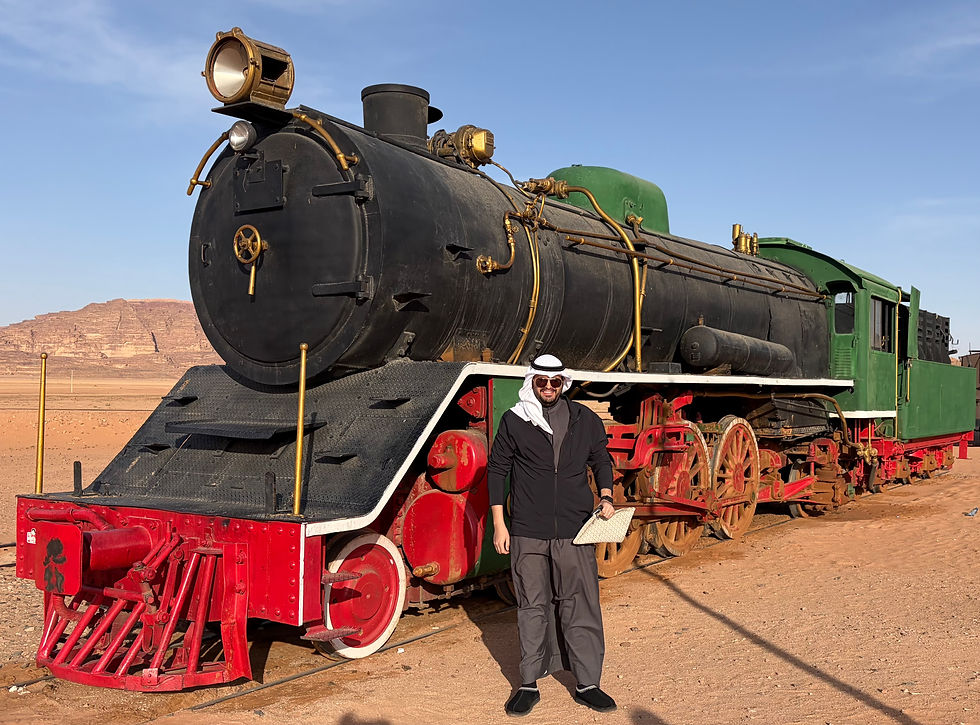
The next morning we have a walk around the resort which is extensive and dip our hands in the Red Sea. Al’a has offered us a boat trip but we decide that we are better to be back in Amman and available for a flight out. We have breakfast and then Al’a has us taste all the Movenpick icecream flavours – not something we usually do at 10am!! It was however lovely. Then we set off on the drive again up the coast road to the Dead Sea. As we get to the Dead Sea there is the most amazing effect which we know we won’t be able to capture on camera as the white mist from the salt in the Dead Sea reaches up into the wispy clouds above. We drive up a stunning mountain road to the panoramic views at the top and visit the Dead Sea Museum https://panoramadeadseacomplex.com/museum/

Tragically the Dead Sea is shrinking every year and the museum provides the history, geology and ecological facts about the Dead Sea. It is in the Panorama Complex and we go to the Panoramic Restaurant where they are setting up for a wedding so we have our photo taken in the middle of a fake rose heart with the Dead Sea behind us!! Lunch in the restaurant is nice although still no alcohol – we are not the only ones there today which adds some atmosphere and the view is amazing. After lunch Al’a drives us back to Amman (the pretty way back through Madaba) and after taking some more cash out from a road side ATM so that we can pay him we arrive back at the Sheraton hotel. We say our farewells to Al’a who has been amazing and made the whole trip so much easier than it would have been if we tried to navigate it ourselves. We have bought him an Aboriginal keep cup and fridge magnets (he loves kangaroos!) so we part with these gifts and his repeated requests to ensure that we let him know that we are able to leave safely.

It is our last night of listening to air raid sirens and to us they seem less – maybe we have got more used to them while we have been here. After an early night we head to the airport where our pass through the various security points is seamless and our flight leaves on time for Heathrow.

An amazing time in a country beyond unlike anything that we have visited before. We hope and pray that peace returns to the Middle East and these beautiful gentle people are able to live the lives that they do in harmony, Muslim, Christian and Jew all co-existing with acceptance of differences between them.


Comments