
The Majesty of the Rocky Mountains


We are up bright and early for our flight from Vancouver to Calgary. The pilot warns it will be bumpy and it is, with two attempts at landing. The weather is truly awful when we land, raining and cold. SIXT (our hire company of choice) has a lovely Audi Q3 waiting for us so at least Tim is familiar with the vehicle as we drive a Q5 at home. This is just as well as he needs his wits about him on the 90-minute drive north to our accommodation in Harvey Heights just 15 minutes south of Banff. The roads are in a shocking condition, and we learn that Canadians take the speed limits as something of a guide to be beaten at all costs. We have booked our accommodation on Stayz – a two-bedroom unit in a purpose-built set of lodges. It is warm and clean, and we have a quick turnaround as our flight was late and we are booked on the Banff Gondola at 7pm.

https://www.banffjaspercollection.com/attractions/banff-gondola/experience .We find our way to park in Banff Station and catch the free bus up to the Gondola. We are early but shouldn’t have worried as with no visibility and falling snow most people have been put off. It is still a great experience going up in the Gondola to the top of Sulphur Mountain which climbs 628m over 10 minutes. At the top, on a normal day, we would have been able to take in sweeping views of six mountain ranges, the Bow Valley and the charming town of Banff, and stroll the boardwalk to the Cosmic Ray Station and Sanson’s Peak. However, due to the dreadful weather conditions, the boardwalk is closed and the falling snow and temperature see us take the briefest of forays outside before heading inside to explore the world-class mountaintop discovery centre, where the story of Canada’s first national park unfolds. We decide to have a buffet style dinner while we are at the top before finding a supermarket and liquor store to get some basics and head back to our accommodation.

It is still raining the next morning although not as heavily and we are up early for our bike ride which we have booked with Get Your Guide https://www.getyourguide.com/banff-l284/banff-mountain-lakeside-e-bike-tour-t603683. Our guide is Em from Sheffield and despite the rain we have the best time. There are just the three of us on this tour which takes us first to the two Vermillion Lakes just outside the town and then on a mixture of bike trails and roads, crossing the Bow River a couple of times, to the Bow Falls lookout. We see the Banff Hoodoos - striking spire-like rock formations made of glacial sediment deposited during the last ice age which are located on the banks of the Bow River. From here we ride up Tunnel Mountain to the Cascade Ponds where we see a lot of ground squirrels. Our next stop is Lake Minnewanka with great views of the Lake and an interesting history.

Before it became the massive body of water known today, Lake Minnewanka was home to a vibrant summer resort village and in the late 1800’s Minnewanka Landing was a popular weekend escape for the folks of Calgary. A large dam project in 1941 caused the lake’s water levels to rise by 98 feet and the entire township was swallowed. Today the area is very popular with scuba divers as the glacial waters have preserved the old cottages and wharf structures under water. We cycle on to Two Jack Lake (so called as Two Jacks couldn’t decide which one to name it after!) and then on to Johnson Lake. Heading back towards town we visit another disappearing town. Bankhead was a booming, planned coal-mining community situated on the slopes of Cascade Mountain, established in 1903 by the Canadian Pacific Railway – it was highly modern with electricity and sewers long before the town of Banff had them. The mine was shut down in 1922 following a major labour strike. Instead of just letting it decay, the entire town was intentionally dismantled. Many of the wooden homes and the railway station were moved to nearby Banff, Canmore, and Calgary. Today Bankhead is an official ghost town. Visitors can hike the kid-friendly Lower Bankhead trail to see rusted mining equipment, the towering tipple, building foundations, and an old coal-mining engine. We walk a short segment of the Fenland trail which explains the ecology of the forests and then cycle back to our starting point at Banff Station. The tour lasts four hours and is worth every minute.

Again, we have very little time as we are booked on a small coach tour to Lake Moraine and Lake Louise that afternoon. Booked on Trip Advisor this again turned out to be a real highlight.https://www.tripadvisor.co.uk/AttractionProductReview-g154911-d28500539-Lake_Louise_Moraine_Lake_Johnston_Canyon_1_5h_Half_Day_Tour-Banff
Edward is funny and makes the whole experience quite unique. We head first to Lake Moraine where he shows us a “secret spot” to take the most amazing photos of the Lake which is particularly beautiful as the ice is still melting in places. We have time to walk around before we get back on the coach to Lake Louise and are treated to a black bear crossing the road in front of our coach as we descend the mountain.

Edward is quick to advise the two cyclists that we pass that there is a bear around! We have longer to walk at Lake Louise and the ice on the lake, near perfect mountain reflections and the famous Fairmont hotel make this a very special trip. Back at our apartment Tim cooks dinner – the oven is awful and so we nearly set the place on fire!


The weather is finally kinder today, so we head into Banff for coffee at Wild Flour – a result of Will’s research on the best brunch location - and then have a stroll around Banff getting a few gifts at the market. We set off up the Icefield Parkway and at last can see what everyone has been telling us – the drive is stunning. We drive through the Valley of the Ten Peaks. Our first stop is Bow Lake https://www.banfflakelouise.com/experiences/bow-lake. Fed by the Bow Glacier and feeding the Bow River it is still partially frozen over and stunning. The walk to the lake edge is just a few paces from the carpark.

From Bow Lake we drive north to Peyto famous for its turquoise waters and wolf head shape. Tim has opted to wear his dress shoes and soon realises that the short 600m walk to the lakes edge is not going to be for him as the path is covered in ice and snow. Will and I set off and Will gives me a big stick that someone has left at the beginning of the path. As a result of the stick we made it safely to the lake edge and back but not before we witnessed all sorts of hilarious human behaviour as people slipped and fell over on the treacherous path. Particularly of note was the woman who had dragged her reluctant labrador dog up. The dog had clearly had enough and was being dragged down the path and making it slippy for all that followed him. The other great sight was the group of Japanese tourists all with their crampons managing the path with ease! The lake was well worth the walk – stunning colours. https://www.peytolake.ca It is named after Wild Bill Peto who was an early guide and trapper in the area. It is said that he once released a live lynx into a bar in Banff to scare off the other patrons so that he could have a quiet drink by himself!

After this feast of scenery we continue our drive, passing the stunning Castle Mountain and seeing wild horned sheep on the road, reaching Glacier View Lodge just after 4pm. Our room is lovely although the weather has once again taken a turn for the worst, so we get quite cold and wet getting our cases from the car and checking in. We decide to dine in the restaurant that night and have a good rest before our big day tomorrow. The Lodge has a huge window in reception with a view of the Glacier and is well serviced with not only the restaurant but also a Starbucks downstairs which we know we will make use of while we are here. https://www.banffjaspercollection.com/hotels/glacier-view-lodge/ Situated 2.5 hours north of Banff and an hour south of Jaspar it feels like the perfect place to ensure that we explore everything that the Icefield Parkway has to offer.

We start the next day with a decent Starbucks coffee and breakfast before joining our Glacier tour with Ethan and Logan. https://www.banffjaspercollection.com/attractions/columbia-icefield A short and informative coach trip from the Lodge to the base of the mountain is filled with facts from Ethan. The Columbia Icefield spans 325 sq km and is the largest icefield in the Canadian Rockies. It acts as a hydrological apex, feeding meltwater to the Pacific, Arctic, and Atlantic Oceans. Its most accessible tongue, the Athabasca Glacier, has receded 1.5 km in the last 125 years and this is where our tour will take us. We step off our coach and get into a quite unique vehicle. Called Icefield Explorers these purpose-built trucks have huge tyres on 6 wheels that are 5ft tall to carry us down into the valley and then up onto the glacier. There are only two other similar vehicles on earth, both located in Antarctica. They weigh 27 tons, equivalent to 60 large grizzly bears and the Columbia Icefield has 22 of them.

Driving it is not for the faint-hearted and we are pleased that Logan has been doing this job for 5 years now! Once out on the glacier it is quite a surreal experience. With the wind chill it was probably around -1 or -2. One of the guides asks me if I want to experience a glacial facial so of course I say yes. This amounts to putting my face into the glacial water stream running down the side of the glacier – absolutely freezing but very refreshing.

Once back on our Icefield Explorer we retrace our journey and pick up a new coach that will take us to the Sky Walk. This wonderful structure at the edge of the Sunwapta Valley is only a short drive from the lodge and enables you to experience fossils, waterfall views and incredible glacier landscapes along a one-kilometre interpretive walkway, situated near routes frequented by mountain goats and other wildlife. The journey is memorable walking along a suspended platform where glass is all that separates you from rugged and wild terrain 280m below. This structure, built in 2014, has facts about all the birds, fauna and flora that live in the valley and in the Rocky Mountains and I learn a new word – phytology, meaning the formal study of plants. The whole tour and experience lasts about 2.5 hours and is excellent.

Back at the lodge we decide that we will take a drive up to Jasper to get a feel for the place. The road is as stunning as the first part from Banff until we get to a section where the massive 2024 forest fires are evident. Jasper is a lovely town, and it is sad to see the many homes being rebuilt and the temporary housing that is there for the third of residents that lost their homes in the fires. We walk up and down the main street, and I get some great Antarctica clothing for my marathon at the end of the year.

There is a huge totem pole – the Two Brothers totem pole - in the centre of the town and a wonderful tribute to the indigenous people and their art with boards containing information about the Stoney First Nation people (Iyethka) who have lived in this area since time immemorial. According to their legend Mother Earth gave them the job of looking after all creations within the mountains and foothills. We are amused to find one by Mackenzie Brown and send our niece the photo of her namesake’s work! We decide to have an early dinner at Earls in Jasper https://earls.ca/locations/jasper where we sit in the sunshine on their rooftop balcony, enjoying the warmth for the first time in several days. Will is asked for ID and seems quite put out – at nearly 28 I think he should have been chuffed! We set off home and are rewarded with the most magnificent male elk on the side of the road. Such a huge beast and amazing to be so close to it. As we near our Lodge Tim realises that we do not have enough fuel to make the return journey to Jasper for our tour in the morning. The closest gas station is all the way south at the Saskatchewan River crossing -there is nothing for it but to make the 100-mile round trip! Needless to say we are tired and ready for bed by the time we finally get back.

We must be in Jasper by 845am so it is too early for our trusted Starbucks brekkie at the Glacier Lodge. We get on the road early allowing (we think) enough time to get a coffee in Jasper. Unfortunately, the only option (Tim Horton’s) had a long queue so we opt for hot chocolate in the Circle K supermarket which has more sugar in it than my yearly intake! We meet up with Sam and the small coach tour that is taking us on our day out in the Maligne Valley. I have booked this through Trip Advisor and can highly recommend it. https://www.tripadvisor.com.au/AttractionProductReview-g154918-d11463858-Jasper_Wildlife_Sightseeing_Tour_with_Maligne_Lake_Cruise-Jasper_Jasper_National

Sam is incredibly knowledgeable – he studies in Quebec (wild fire management) and has been working every tourist season in his holidays in Jasper for many years. During the day we learn many facts about the wildfires in 2024. He explains that the strange effects we saw on the trees on our journey to Jasper are the result of leopardisation - the locals call them “cheetah” or “leopard” trees after their spotted black and yellow appearance, and they’re the result of an explosive release of heat and pressure courtesy of the moisture that hides behind the thin outer bark of lodgepole pine trees. While wildfire management is prevalent now, for 90 years there was a policy of supressed burning and the wildlife and forest health suffered immeasurably as a result. As we drive towards Medicine Lake he explains that there are only 20 male elks in the park – we feel very privileged to have seen one the previous night. The elk is also known as wapiti derived from a Shawnee and Cree word meaning "white rump". It is named after the distinctive light fur around the tail region which the animals may fluff-up or raise to signal their agitation or distress to one another, when fleeing perceived threats, or among males courting females and sparring for dominance. They are second in size only to the moose so it is not surprising that we mistook our sighting the previous evening initially as a moose.
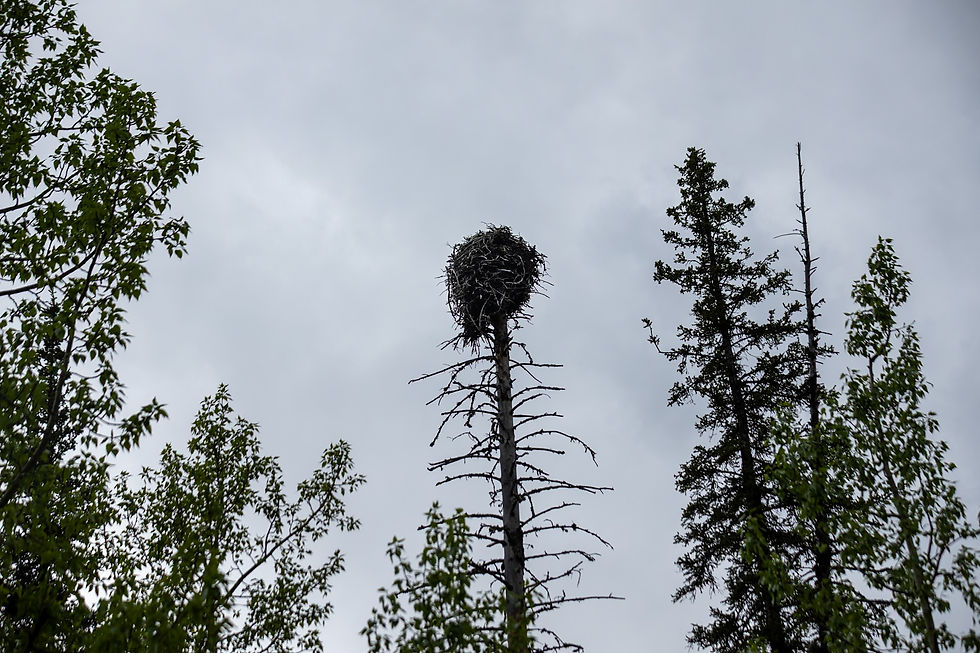
Medicine Lake is very beautiful and known as the disappearing lake. https://parks.canada.ca/pn-np/ab/jasper/activ/itineraires-itineraries/medicine It is 7km long and lies where massive summer glacial melt fills the basin. During autumn and winter the water drains through underground limestone caves, turning the lake into a system of mudflats. It sits atop one of the largest known sinking river systems in the Western Hemisphere. The water that drains away re-emerges some 16 km downstream at the Maligne Canyon (which we visit later in the day). Along the side of Medicine Lake we spot an eagle’s nest and two eagles sitting proudly up the top of the tree guarding their young. On our return trip on the other side of the road we see an osprey again watching over its young. Osprey are unique among birds as they have an outer toe which they can reverse backwards enabling them to grab very slippery fish. From Medicine Lake we travel to Maligne Lake, spotting a male elk on the way.

At the shore of Maligne Lake we catch a boat trip to Spirit Island. The lake is famous for the colour of its azure water, the surrounding peaks, the three glaciers visible from the lake, and Spirit Island, a frequently and very famously photographed islet. You cannot go onto Spirit Island – we take a lovely boat trip up the lake (which is 22km long) to where we can step ashore and take our photographs. It is a very sacred place for the first nations people and you can see why. Standing there in amongst the serene beauty is deeply moving. https://parks.canada.ca/pn-np/ab/jasper/activ/itineraires-itineraries/lac-maligne.

Back with Sam we set off to retrace our steps when he spots a moose walking through the forest on our left. He reverses the coach and we all get out and follow him down a bank opposite where the moose is having a drink in a small lake. The moose is very calm and seems aware of our presence and not bothered by it. Sam explains that he has a dewlap or bell - a hair-covered flap of skin hanging from its throat. While its exact biological purpose remains a mystery, scientists theorise it functions as a scent-spreading billboard during mating season, a visual indicator of dominance, or an evolutionary leftover. Then Sam spots one member of our coach party – Bob – who for some reason has not followed us to the safe watching space but instead is now a few feet behind the moose. Sam waves to Bob to get out of there quickly as the moose can become violent if you get in its path. Bob explodes from the forest unscathed and we all watch silently as the moose calmly trots past us and makes its way back into the forest. I must admit it was such a magnificent sight that I shed a tear or two.

Our adventure filled day is not over as we stop again a few kms further up the road and see a black bear making its way up the hillside. Sam explains that we are very lucky to see elk, moose and bear on one of these trips. Our final stop at the Maligne Canyon. Maligne means “wicked” and the canyon is quite stunning with the water running through it at quite some force. The water only flows from May to December as it is frozen for the other months. A region with underground drainage is known as karst.

Scientists think that the Maligne Karst must have a major cave somewhere within its depths, judging from the large volume of water flowing through it underground, and the speed at which the water travels. Several entrances to the system are known, but in every case the passage is blocked. It truly is one of natures mysteries. https://www.jasper.travel/blog/10-important-facts-about-maligne-canyon/ . It has been a day full of amazing sights and we head back for our last night at the Glacier View Lodge, which has been a fabulous base for our Rocky Mountain adventures. We have dinner in the restaurant and agree on a later start the next day for our journey back to Calgary as our flight is not until 6pm.

We have a lovely slow start and a Starbucks coffee before checking out and heading down the Icefield Parkway. I had offered to drive but was glad Tim rejected this idea as there was some heavy snow enroute! We see some runners on the road and on investigation it turns out that we were witnessing the Banff to Jasper road relay - a legendary 260 km, 15-stage team running event winding through Banff and Jasper National Parks in the Canadian Rockies. Held annually in early June, teams of 6, 9, or 15 runners tackle the world-famous Icefields and Bow Valley Parkways, followed by a post-race party in Jasper. Believe me when I say that after tackling those hills in the cold and snow they fully deserve the party! We make a stop at the Mistaya River for a walk down to the amazing canyon and falls. The water is once again from the glaciers and the Peyto River and the formation of the rocks is truly stunning. https://www.banfflakelouise.com/experiences/mistaya-canyon

We drive on and visit Canmore for lunch and soak up the warmth and the sunshine after the chill of the morning. We have lunch at The Local https://www.thelocalcanmore.com/and the waiter is a Watford supporter and can’t believe that the other one is my son Jack! After a brief visit to a very impressive sweet shop we drive onto Calgary, drop off our hire care and head to the airport. Our flight is delayed so it is very late when we eventually get to Toronto, drop Will off and then head to our hotel - around 4am. We agree we will decide on a meet up later in the morning when we see how we all feel.

Despite the flight ending, the time in the Rocky Mountains has been a magical experience and very special to share these memories with Will.
Photos courtesy of @alpstobeachphotos


Comments